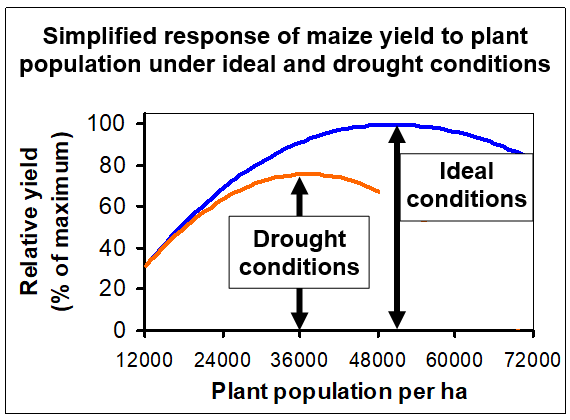
Maize responds to plant population in a fairly predictable manner. As plant population increases from a low level, yields increase up to a maximum and then as population increases further, yield decreases and plants tend to fall over (lodge).
The effect of plant population on maize
Apart from the impact on yield, plant population also influences the maize plant in the following ways:
| Increases | Decreases |
|---|---|
| Plant and cob height | Stalk thickness |
| Lodging (both stalk and root) | Cob size |
| Nutrient and drought stress | Seed size |
| Leaf and cob diseases |
However, these responses are a function of the variety and growing conditions.
Variety
Most of Zamseed maize varieties, especially in the medium and later maturing classes, are large-framed, tall and leafy plants. Therefore, they tend to produce their highest yield at 45,000 to 55,000 plants per ha. The ultra-early and early hybrids are a little shorter and may be planted at 55,000 to 60,000 plants per ha, especially under good conditions. Individual varieties also respond differently to plant population, with some being more prone to lodging or leaf diseases than others, and so it is important to check this on the variety catalogue. However, the ideal plant population of any variety is highly dependent on the growing conditions.
Growing conditions
The optimum plant population depends on two main things.
The water supply
Water is essential for plant growth, but often, especially in dryland farming and in Region I and II, drought or insufficient rainfall is experienced. Where rainfall is limited, then a lower plant population of around 36,000 to 40,000 plants per ha is recommended. This is to allow individual plants a greater supply of soil water in a low rainfall regime. However, if ideal rainfall conditions are expected or irrigation is available, then hight plant populations of 45,000 to 55,000 plants per ha are possible. Rarely is it necessary or advisable to establish more than 60,000 plants per ha, unless the variety can handle such high plant populations and the environment is conducive to good crop growth.
Soil fertility and sunlight
Plants draw most of their nutrients from the soil, but they also require sunlight to grow. As plant population increases, so does the competition between plants for nutrients and sunlight increase. Thus, it is often better to think of fertilising individual plants rather than the total area of crop. For example, if you plan on applying 300 kg/ha of basal fertiliser, this is equivalent to 8.3 g per plant at 36,000 plants/ha or 5 g per plant at 60,000 plants/ha. This amount of fertiliser would be insufficient for each plant at the higher plant population, and thus, to apply the same amount of fertiliser per plant at 60,000 plants/ha as for 36,000 plants/ha, you would need 500 kg/ha of fertiliser for the high plant population. Thus, fertilise the crop according to the plant population and yield target based on the environmental potential.