

The sowing of any crop is a critical time for determining the outcome at harvest. Without an even and vigorous stand of the optimum number of plants established in a healthy soil, a crop will start its life in a poor way. Weak, unevenly spaced plants that are either inadequate or too many will perform poorly. The problem is that when planting under dryland conditions, the weather or soil conditions sometimes cause uneven stands. There may be places where the seed fails to emerge resulting in gaps in the row, or seed germinates at different times within the row, or the plant population is below the ideal across the entire field. In such situations, what can be done?
Key principles first
To establish a maize crop with the best chance of success, the following principles are proposed. Maize performs best when a uniform stand of plants is established at the optimum time and spacing. Earlier (November) planted maize yields better than late (December or January) planted crops. For any given planting date, the optimum plant population is between 44,000 and 55,000 plants per ha for Regions II and III. Lower populations of 36,000 to 44,000 plants/ha are suitable for lower rainfall (<600 mm) areas (Region I). Maize should be sown at a uniform depth of 5 cm, into a friable seedbed that is at field capacity (i.e., has good soil moisture) to at least 60 cm depth. There should be good seed-soil contact, and the soil should be of balanced fertility.
Two scenarios
1. The plant stand is below optimum with gaps in the row
Generally, when a crop fails to emerge at the desired plant population, the field is “gappy” – in other words, there are gaps in the row where there are missing plants. These gaps are typically patchy, and so two things need to be assessed: First, what is the average plant population? Second, how big are the gaps between plants?
The general relationship between planting date and plant population on the yield of maize is given in the graph below. This indicates that whatever the planting date, the lower the plant population below 50,000 plants per ha, the lower the yield. Thus, if the expected plant population is 50,000 plants per ha, but the actual average plant population is 30,000 plants/ha, yield will be reduced by about 20 %, assuming a uniform stand. However, if the stand is patchy, in other words, there are some long gaps within the row but there are some patches where the plants are close together (usually caused by poor planter operations), then yield loss will likely be greater than 20 %. The options, therefore, are: one, do you replant the entire field; or two, do you fill in the gaps? The answer depends on the time it will take to replant and the length of the gaps in the row.
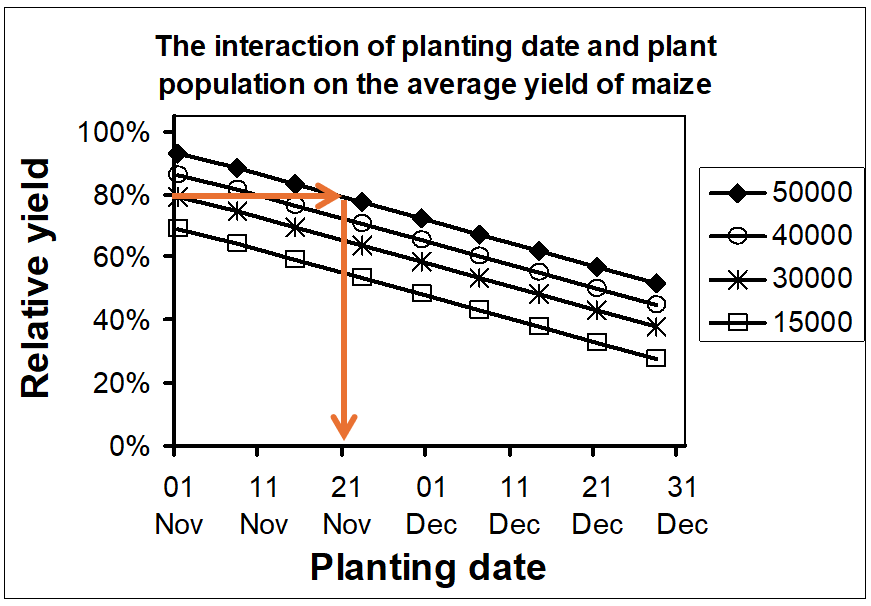
This graph may be used to help make replant decisions. For example, if you planted on 1st November hoping to establish 50,000 plants/ha, but because of poor rains or whatever reason, you only established 30,000 plants/ha, then you must replant within about 21 days and achieve at least 50,000 plants/ha to obtain a similar yield than if you simply left the stand as it was. Thus, the earlier you replant a poor stand, the better. If you replant a poor stand after 3 to 4 weeks from the original planting date, you might not achieve as good a yield, especially if the plant stand is 75 to 80 % of the original planned population.
Similarly, if you decide to fill in the gaps, then the gaps need to be more than 1 m in length, and the planting must take place within 21 days of the first planting date. If the gaps are shorter than 1 m, then the in-filled plants will be shaded and out-competed by the first-emerged plants.
2. The plant stand is uneven in emergence time
It is sometimes the case that plants emerge at different times in the field. This may be due to variable planting depth or variable soil moisture, such that some plants emerge later than others. Generally, this is less of a problem than low plant populations. If the time variation in emergence of some plants is less than 7 days, the impact on yield will be negligible, if anything. However, if the time variation is greater than 7 days, such that significant numbers of plants are delayed in emergence, the impact on yield will be greater, depending on the extent and pattern of emergence and the time delay.
Individual plants that emerge 7 days or more later than their neighbours, will be shaded and outcompeted, and will not contribute much to yield, especially if these delayed plants are relatively few in number. The greater the number of delayed-emergence plants, the greater will be the yield loss due to the planting date effect.
As a rule, provided the plant population is close (within 10 %) to the optimal for the field context, it is unlikely that replanting a field that has variable emergence times will be beneficial to yield. It is better to leave the field and manage it to best advantage. The main problem will come at harvest when there will be plants at different stages of maturity, and the field will have to be left until the later emerged plants have dried down sufficiently for harvesting.
Conclusion
When crop establishment is less than expected, the difficult decision is whether to re-plant or not. This depends on the actual average plant population achieved, and the variation in the plant stand. The lower the plant population, the more likely will replanting secure yield expectations. However, replanting must be within 21 days of the original planting date and a good stand must be established to be give the best chance of achieving the expected yield from the field. Where there is a lower-than-expected plant stand and this is characterised by patchiness or random long gaps in the row, gap-filling is a good option, especially if this is done within 21 days of the original planting date. Finally, if the plant population is adequate but the stand unevenness is due to variation in time of emergence, replanting is not likely to improve field yield performance.